My Top 10 fish to catch & eat
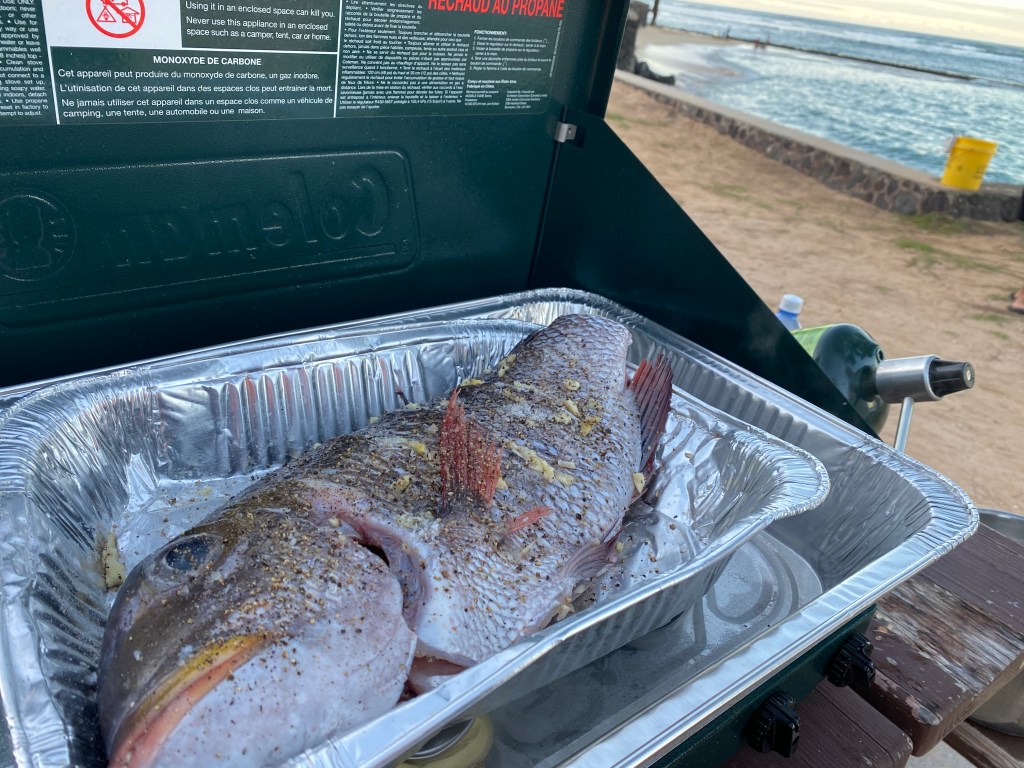

Over the years, I’ve eaten a lot of fish, but some I like more than others. Most of the fish I like are meaty and don’t have much bones, but there are certain exceptions. Some of the other shoreline fishermen have submitted their top ones as well.
My top ten list for shoreline fish only is as follows (ten being the lowest out of the ten and one being the best out of the ten):
- Mu. In my opinion this is a well-deserved top spot. Mu are very meaty, have no bones except for the center bone, and have no fishy taste to them. Steamed chinese style with onions and garlic, and a little bit of butter, it is heavenly, and cannot be beaten. You don’t even need to pan fry this fish to make it good. Baking or steaming is the best way I think. Maybe roasting would be good too.
- 2. Uku. This one was a tough fight against Moi. Even though it isn’t caught often from shore, it still lives pretty close to shore, where shorecasters catch them sometimes. This is a non-fishy fish, and about the same as the Mu. No bones except for the center and has a very mild taste. However, sometimes they have ciguatera poison in the areas of the head and stomach region. Don’t let that stop you from eating it though. Occasionally on restaurant’s special of the day list.
- Moi. Some people would put Moi in the top spot, and I would too, but after Mu and Uku, I think that Moi should belong in the number three spot. Moi is a very moist fish that is often served in Japanese izakayas. In the izakayas, they serve it deep fried with special salt and a ponzu dipping sauce. It is a killer dish, and that is that is why I go to izakayas a lot. In particular, Uosan (Ala Moana/Ward area) has very good Moi, as well as a lot of other dishes. However, they are very hard to catch, so your best bet at eating one unless you are one of those Moi hammahs is at a Japanese izakaya.
- White/Yellowspot/Omilu Papio. All species of Papio are great eating. They are a meaty fish, and have more bones than Mu or Uku, but the taste is definitely there. It is mild, and a lot easier to catch than Moi, Uku, or Mu from shore. However, they are still somewhat difficult to catch, especially during the winter months. Certain species of Papio have their strengths in eating. Yellowspot Papio make fantastic sashimi, and lots of bottom fishermen praise Yellowspot Papio for their moist and fatty flesh. Omilu are great any way possible, sometimes a little fishy as it gets bigger. White Papio when they are small are very mild, tasty, and soft. However, once they reach Ulua size, their table fare rapidly goes down. Some Ulua fishermen love to eat Ulua, but there is risk of ciguatera and the meat is quite dry and tough when it gets big.
- Aweoweo. In my opinion, Aweoweo are a great eating fish. I like them steamed chinese style and a ponzu or soy dipping sauce. They are somewhat easy to catch if you know the spots to catch them, but however, I don’t know the right spots for them. I would assume they are good fried as well. I know of one restaurant that served them as a special once.
- Toau. Toau are very abundant, and easy to catch if you are light dunking at nighttime or dusk/dawn. They have a lot of bones, but when they are over ten inches, they have more meat than bones, and become good for eating. If you fry them enough, you can eat the whole fish, even the bones, if you cook it until it literally shrivels up. However, that is a waste of oil. They are good steamed or pan-fried. Pan fried, you can add shoyu, garlic, and onions to make a great meal. Throw in some butter and parsley to make it even better.
- Small Halalu. Small Halalu when deep fried with panko and oil are very good, almost like french fries. Upper class restaurants will sometimes have deep fried smelt, this is very similar to it, but homemade. Japanese restaurants sometimes sell them labeled as baby Aji. Aji – Akule
- Small Oama. Same as halalu, but a little less meat and more crunch.
- Menpachi. A very flaky fish, good pan fried in butter and oil, with salt, pepper, and other garnishes. You can also deep fry them, but their main flaw is that you have to scale them more than other fish, since they have a lot of big scales similar to Toau. Some restaurants serve them as a special occasionally.
- Po’opa’a. I ran out of best options, but Po’opa’a is has decent table fare. They are a huge pain to clean, I would only bother with the bigger ones. Their two filets are just perfect size to make into fish and chips. Soft and meaty. However, there is quite a bit of fish taste to it, so be advised of that.
Please understand that this is all opinion, but in my mind these are my top fish. Keep in mind that I have never tried Nabeta before, and I’m sure it would be on there if I had tried it before.
Happy New Year
For the new year I decided to go back to an old spot along with 8-yr old Jacob and his mom.

I started off from shore, but with no bites I decided to wade out to the breakers. I casted and got a nice 11″ papio, but my camera was broken, so I couldn’t get a picture of it.
I kept casting and got two nunu and two Po’opa’a before a nice sized fish broke me off. I switched to my go-to lure and started casting into shallower water. Within a few casts, I hooked a screamer that ran for a while before popping off. A few casts later, I hooked another screamer, but this one stayed on. I fought it halfway in, but then it dove into a rock. I waited for around a minute until it came out.
I kept slowly bringing it in, and then it dove in another rock, and came out again. This same stubborn cycle kept repeating itself over and over again, until I finally got it to the rocks and grabbed it by the tail. It was a nice size Omilu, and a nice one to start the year. It was probably three pounds and was a super good fight on the new light rod.

After that, I went back and Jacob wasn’t doing so bad either. He caught a bunch that day, including two Papio, two Po’opa’a, two humu, and a hinalea. For someone that young, he did very good and I can’t wait to see what will come from him when he gets older and can access better spots.
Even my mom caught a nice Moana, which wasn’t that surprising because every time she fishes she catches but since she never fishes, she hardly catches. I keep telling her to keep trying, but hopefully one day she’ll commit to it.
It was a nice new years day fishing session, and afterward my family went to Sorabol, a Korean restaurant by Ala Moana. The food was pretty good and the barbecue chicken was to die for.
Thanks to Allison and Jacob for coming out, and to a good session that day. Hopefully we’ll be able to fish again sometime soon. All fish were catch & release except this one…
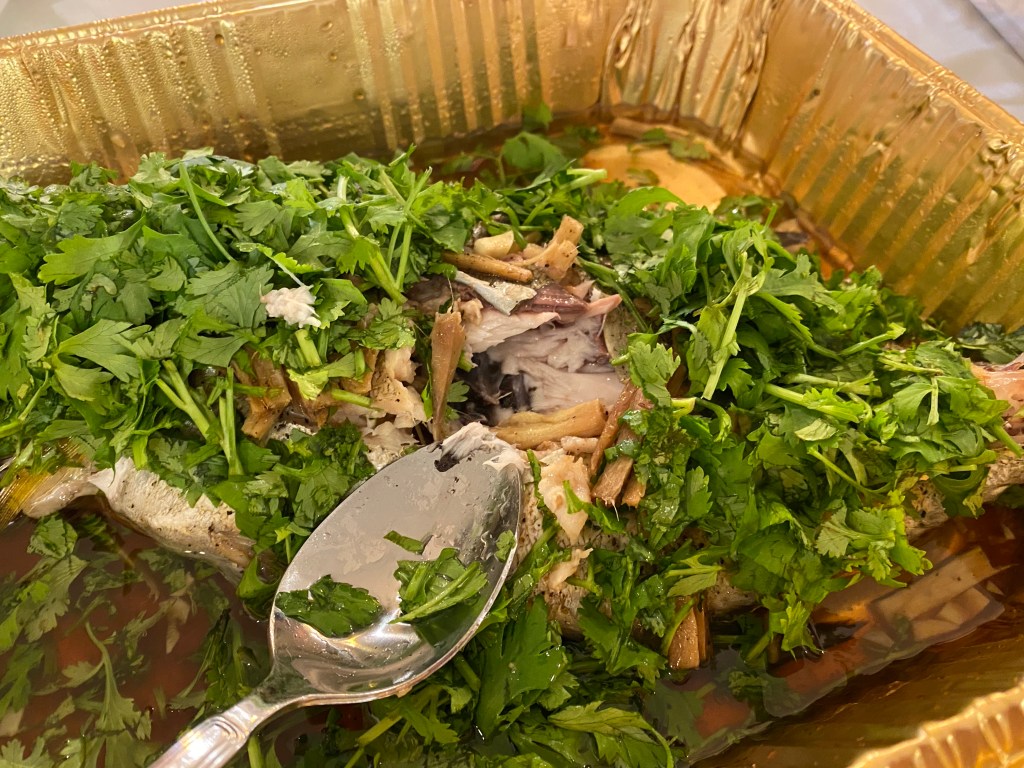
Chinese style papio:
Season fish with salt/pepper, cut slats in the fish and shove some garlic and ginger, then steam for 15-20 minutes, check to make sure fish is cooked through. Heat peanut oil in pan til sizzling, throw in garlic and ginger then pour sizzling oil over fish. Add shoyu, garnish with green onion or cilantro. Serve immediately.
Dirty Water Fishing (Topwater blowups)
Check out my Youtube and subscribe to see more fishing!
Fishing the Ala Wai
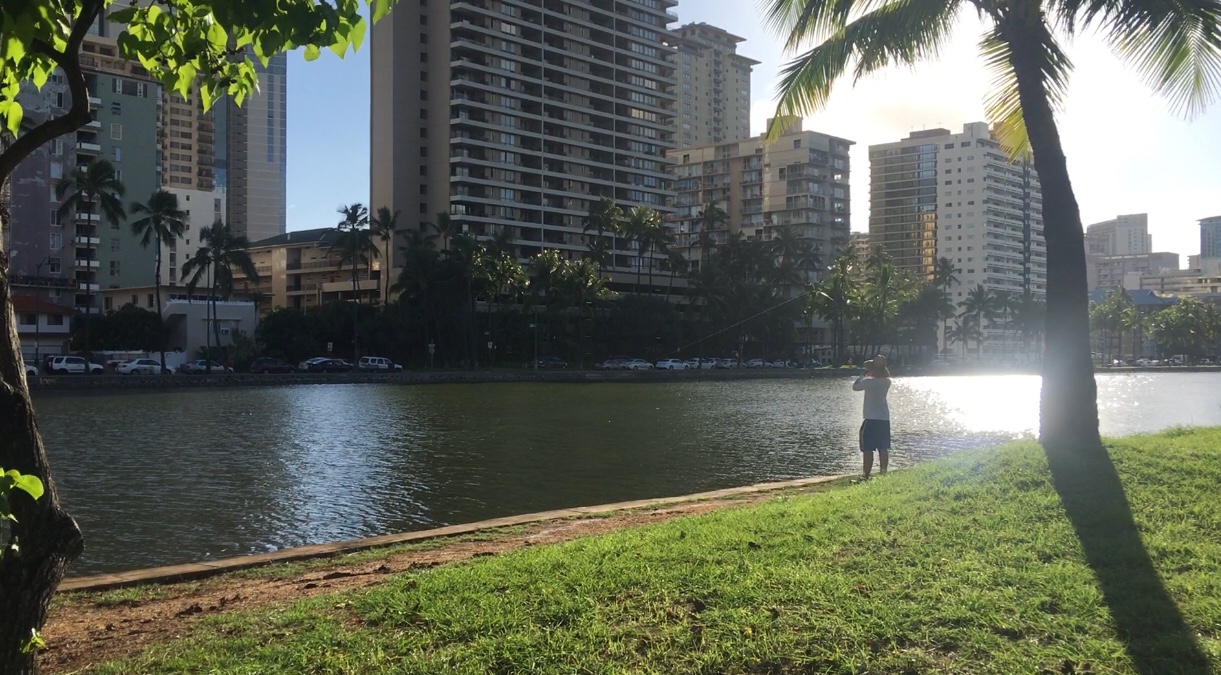
Most people think of the Ala Wai as a stinky, bacteria filled canal, and that’s very true, but fishermen see it as a gold mine for fishing. Some of the less brave fishermen don’t fish it, so that takes away most of the crowd. But the fish that do remain in there have seen just about every lure on the market, including grubs, spoons, and poppers. So you have to switch it up a little bit. I use JDMs, which are lures that are made in Japan. I took Jacob, other Matthew, Luca, and Vance fishing today at the Ala Wai. The first hour and a half was very boring, with no strikes, until I switched it up the the JDMs.
I tried the Shimano Shallow Assassin Flash Boost 99mm, which is a solid lure, but I had never tested it much. First cast on it and boom, a nice Omilu hits it but the side treble got stuck in its scutes, which made it feel huge. I kept fishing with it for a while, and eventually landed a decent White Papio, and a good size Kaku. Then I switched the the JDM model of the Lucky Craft Sammy. First cast, and I could see a Kaku following it in. I paused the lure for a second and it jumped on it and immediately went airborne. I tagged and released it quickly and got back to fishing. I landed one more on the sammy before I decided to switch it up to the secret JDM lure that I’ve been using recently.
No surprise at all, I landed four fish on it, three of them Kaku, all violent and exciting strikes, but then I saw a bait school getting busted on in the middle of the canal. I casted far out there and saw four or five White Papio each fighting each other for the lure. They missed it many times, but one eventually grabbed it and stuck on. Right away it started peeling drag. It took an easy 30 yards on the ultralight setup and I started to get concerned of the huge log it was trying to run into. I radioed back to my mom that I had a big one on, and I decided I had to lock down and boost it or lose it. Remember, this is six lb line main with a 2500 size reel, an ultralight setup. I lock down the drag and muscle it out from the log and close to where I could see it. When I saw it, my heart dropped. One treble was in its mouth and hanging by a flap of skin. I loosened up the drag, and that must be when it saw me and it took another 30 or so yards. It kept resisting for another minute or so before I got it close again. I kneeled down and grabbed the leader, and brought it up onto land. It was the biggest Papio I had caught in a while, so I was of course happy, and tagged it and released it. This was on a rising tide, and was around 2.1 feet when this happened.
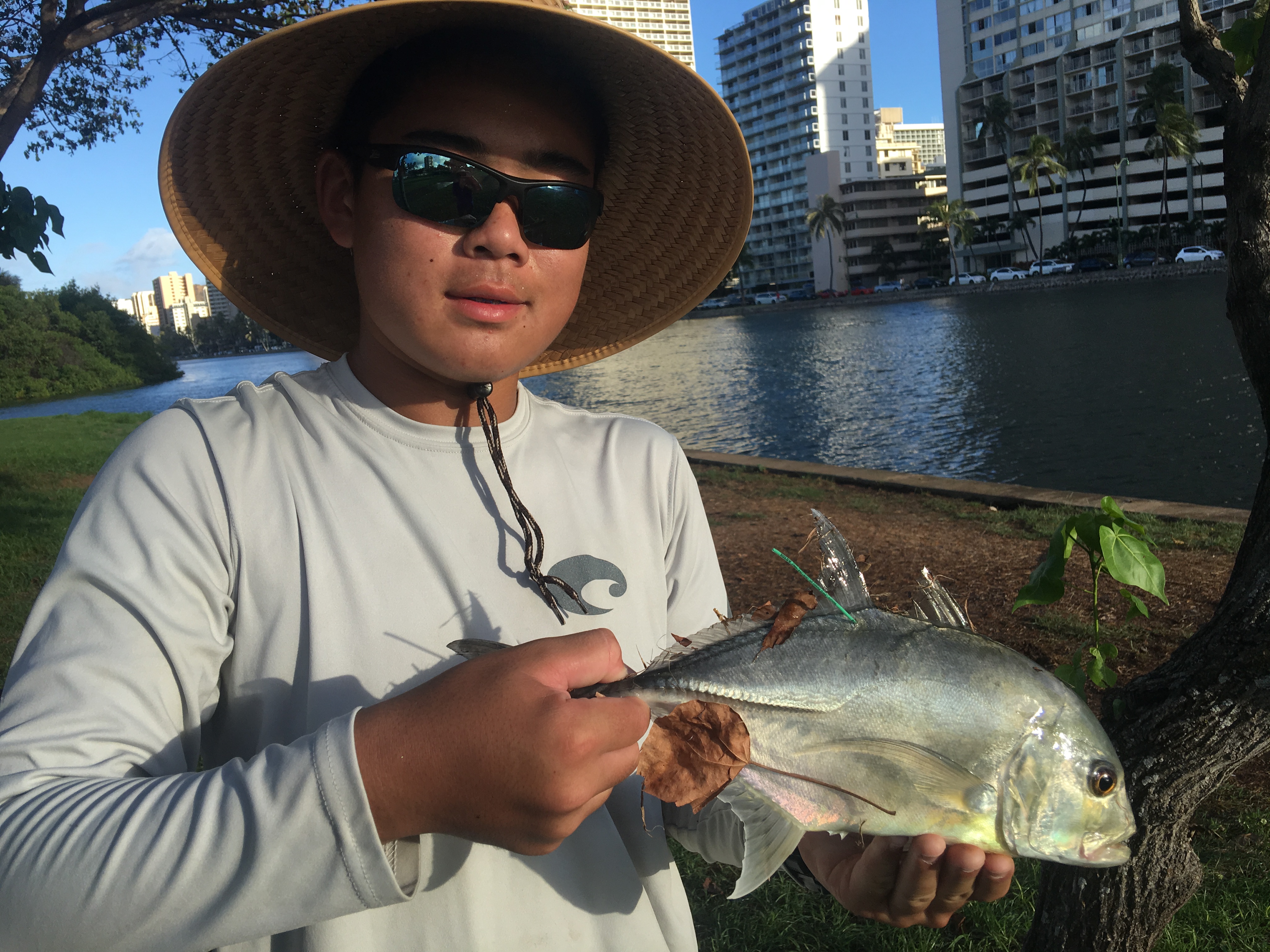

June 2019 interesting catches
Here are some of my surprise catches last month!
Fishing in Japan
Check out my short recap from Spring Break 2019:
“Japan tackle shopping and fishing”
Holoholo: Japan tackle shopping and fishing recap by Matthew
Offseason fishing for big Smallmouth Bass in Hawai’i
Over the past few weeks during off season, I have been going bass fishing to make up the loss of fish in saltwater. I caught multiple bass so far, and they fight with the speed of a Papio, but with the jumps of an Aha.
I found a good-looking spot on Google Maps, and used a Campania Lures Opelu gold hybrid, and casted it out into the middle of the stream. As soon as it hit the water, a smallie bit and I was on! It jumped a few times, and ran into the bank. I fought it out, and then lipped it, then brought it up. It was a good fish, maybe around 10 inches, but the better part was yet to come.
Over the next week, I went to that same spot a few times, all the time catching fish, but nothing too big (only 7-9 inches). But one day, I switched to a spoon, and jigged it like a knife jig. I got a huge strike and it started pulling drag, and I knew this was a big smallie. It jumped once and I confirmed its size. It put up a really good fight, then at the last minute, swam for the reeds, and got stuck. I had to wade out and grab the fish, but I was really excited to get such a big one. It was around 12.5-14 inches, and was a nice brown color. I showed it to my mom, and she took a picture. I plan to fish this spot again soon.
#Shorefishingoahustyle #smallmouthbass #bass #offseason

Welcome to my blog!
Thanks for joining me!
I started fishing when I was nine, and after catching my first fish, I was hooked. I got better and better at fishing through trial and error, and eventually started writing about my experiences, and finally decided to make this blog. My family is not a fishing family, so I rely on books and tips from other fishermen, as well as my own personal experiences. I am currently in 7th grade and don’t plan on stopping fishing anytime soon. Please subscribe and thanks for viewing this site.
~ Matthew I.
Follow my Instagram at @Shorefishing_oahu_style
 Shore Fishing Oahu